
Echo Chamber
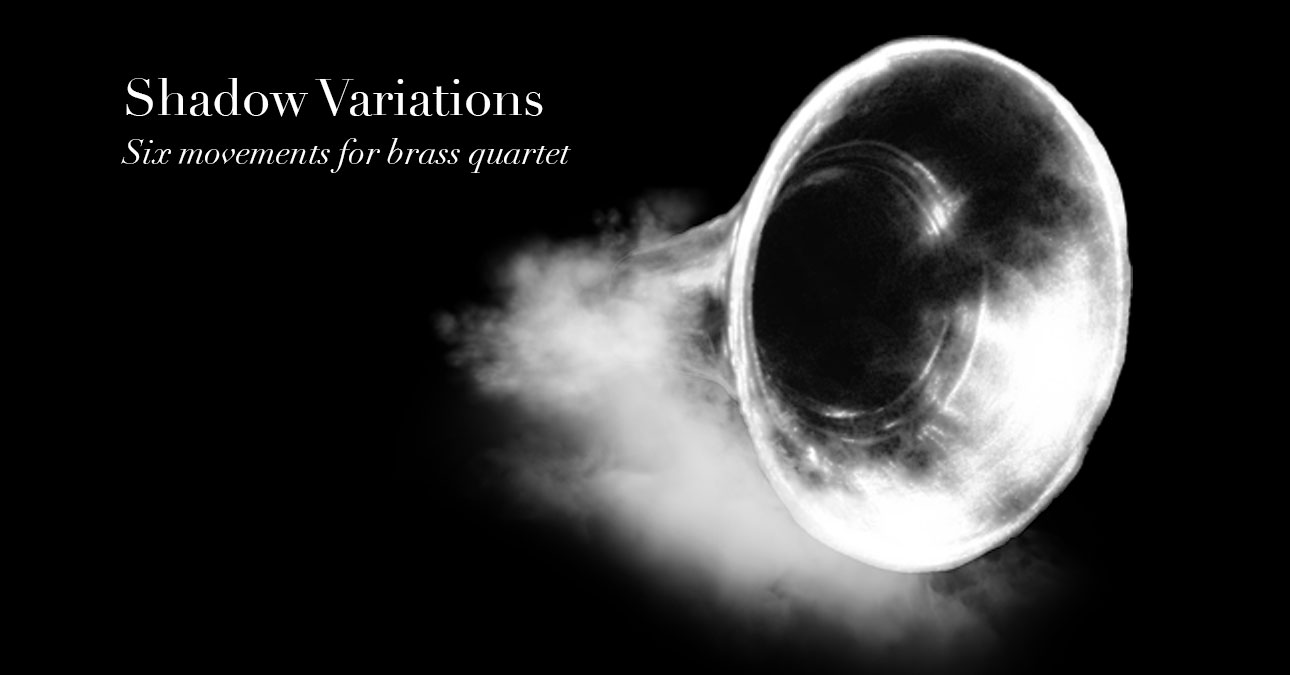
Shadow Variations: Six Movements for Brass Quartet
Now streaming everywhere.
Four metal bodies.
Four columns of breath.
No fanfare.
Just pressure, shaped carefully enough to become calm.
Shadow Variations is the newest release in the Shadow cycle: six movements for brass quartet, written for horn, trumpet, trombone, and tuba. Four instruments, each turning breath into resonance through its own chamber of metal.
Where Shadow Etudes sat alone at the piano, Shadow Intervals moved through the shared tension of strings, and Shadow Interludes turned toward air, Shadow Variations turns toward pressure.
Not loudness.
Pressure.
Breath forced through tubing.
Air becoming weight.
A signal travelling through metal before it reaches the room.
A brass quartet brings a different kind of physicality to sound. Even when quiet, brass has mass. It carries ceremony in its bones, warning in its edges, and a strange gold-lit gravity in the centre of the sound. The challenge here was not to make brass disappear. It was to ask these instruments to hold a pause without pretending they was anything other than brass.
The horn rounds the edges. The trumpet cuts a blade of light. The trombone shifts between warmth and architecture. The tuba holds the floor.
Together, they become a pressure system. Not a block of sound, not a fanfare, not a declaration, but a chamber where breath learns how to carry weight.
Variations, not decorations
A variation is sometimes treated like ornament.
A new costume.
A familiar thing made flashier.
A pattern with different wallpaper.
But here, variation is the method.
The Shadow cycle keeps returning to the same underlying breathing architecture, but each ensemble changes the body of the experiment. Piano gives clarity. Strings give contact. Woodwinds give air. Brass gives pressure.
Same breath counts.
Different physics.
That is the question at the centre of Shadow Variations:
What happens when the same breathing structures move through metal?
What happens when calm has weight?
What happens when stillness is not soft, but pressurised?
These six movements live inside that negotiation: between breath and resistance, between signal and restraint, between force and release.
They are not battle pieces.
They are not arrival music.
They are not royal entrance music.
They are quiet pressure chambers.
Aeris I–VI
Each movement is titled Aeris. Air, yes. But also, something older and more metallic: bronze, brass, substance, object. The title sits exactly where this album lives.
Air and metal.
Breath and weight.
A soft human mechanism moving through something hard and resonant.
Tracklist:
1. Aeris I
2. Aeris II
3. Aeris III
4. Aeris IV
5. Aeris V
6. Aeris VI
Released July 31, 2026.
How to listen
Listen in order if you want the full arc: Aeris I through Aeris VI.
Choose a single Aeris if you need to release one pressure valve:
Aeris I for structure.
Aeris II for ignition.
Aeris III for downshifting.
Aeris IV for release.
Aeris V for steadiness.
Aeris VI for the long exit.
Headphones help. Stillness helps. A little darkness helps.
But the music does not demand a ritual. It can sit beside reading, walking, thinking, resting, or letting the room slowly unclench around you.
And if your mind wanders, good.
That is part of the design.
The tuba will still be there. The pressure will still have a floor. The breath cue will still be waiting when you return.
Shadow Variations is out now on all streaming platforms.
If you listen, let me know which Aeris kept resonating after the room went quiet.