Shadow Scores
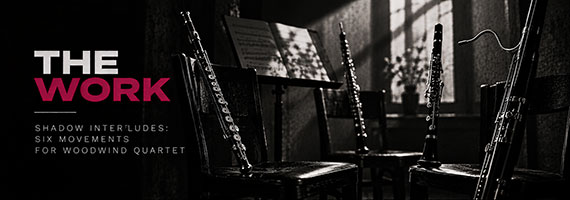
Shadow Interludes: Six Movements for Woodwind Quartet
In this episode of Shadow Scores, SRNMC steps behind the score of Shadow Interludes: Six Movements for Woodwind Quartet, the next release in the Shadow breathing cycle. Diving into Ventus I–VI, the episode explores the most literal instrumentation in the cycle so far: flute, oboe, clarinet and bassoon shaping breath into structure. Unlike piano or strings, these instruments cannot sound without air passing through them. Breath is no longer simply an idea behind the composition. It becomes part of the physical mechanism producing the music. The episode looks at how the established 60 BPM design logic changes when it moves into a woodwind quartet, and how four distinct instrumental voices use airflow, phrasing, space and silence to create a shared musical architecture. Across six movements, Shadow Interludes becomes a study in air as architecture, quiet as function, and music as a place to pause without disappearing. The result continues the language of the Shadow cycle while shifting its focus towards something more physical: the breath required to make sound at all.
00:00
Intro
03:09
Why Woodwinds?
04:19
Interludes: The Room Between
08:05
Ventus I
10:12
Ventus II
12:55
Ventus III
15:56
Ventus IV
18:56
Ventus V
22:08
Ventus VI
25:19
Feeling the Music
26:47
Listening Map
27:38
Next Experiments
28:20
Outro
00:02
A piano presses, strings glide, and woodwinds breathe. That sounds obvious until you try to compose for it, because with woodwinds, breath is not just hidden beneath the music, it is the music's engine. Every phrase has lungs, every line has a limit, every silence has a body behind it. This is Shadow Scores. Welcome back to Shadow Scores.
00:41
Part confessional, part laboratory, part interplay of sound and silence, shadow and light. I'm Srnmc, composer, scientist, lifelong scribbler of staff lines. Each episode, I take you behind the score, into the how, the why, the constraints, the architecture, the hidden mechanisms that make a piece feel inevitable. Tonight, we're stepping into the next release of the Shadow Cycle, Shadow Interludes, Six Movements for Woodwind Quartet.
01:20
This album continues the Pausing Point breath series. Same underlying brief, but here's a quick recap if you're new to the cycle. The design logic is simple on the surface. Each piece is built around a specific breathing pattern set at 60 beats per minute, so one beat equals one second. The music becomes a timing environment, not a click track, not a metronome wearing an ice coat, a musical structure the body can follow without being shouted at.
01:52
The breath pattern shapes the form. When your breath inhales, the music ascends. When your breath holds, the music holds or hovers. And when your breath exhales, the music descends. The anchor for that musical breath shape has changed with each album. In Shadow Etudes, it lived mostly in the piano's left hand. In Shadow Intervals, it was most often seen in the cello.
02:20
And here, in Shadow Interludes, it settles into the bassoon. Same breathing architecture, different body. The brief remain to write music that can support breathing patterns and mental states. Focus, energize, calm, relax, balance and unwind. But by the third album in this cycle, the problem changes. With Shadow Etudes, I was asking, how can a piano guide breath?
02:52
With Shadow Intervals, I was asking, how does a group sustain that guidance? And now, with Shadow Interludes, the question becomes more direct. What happens when the breathing cue is carried by instruments that literally need breath to play? After piano and strings, woodwinds felt like the next threshold. Piano is percussive. You press a key.
03:17
A hammer strikes. The note begins dying immediately. Strings are continuous. A bow can hold a tone and stretch it through time. Woodwinds are different again. They have a mouth behind them. A reed. A column of air. A phrase that must eventually run out. Even when digitally rendered and not physically breathing in the room, the writing still carries that logic.
03:48
Woodwind lines imply lungs. They imply intake. They imply the human limit. That makes them perfect for this project, but also slightly tough. Because if the writing is too busy, the breathing idea begins to break down. If the writing is too plain, the music becomes instructional. My goal with the Shadow Cycle has always been to create music that can guide the nervous system, yet still survive on its own as art.
04:20
So why Shadow Interludes? An interlude is typically treated as something between larger things. A pause. A passage. A small room between heavier doors. But for this album, the interlude is not merely a filler. It is the subject. These pieces live in the in-between. Between breath and tone. Between body and instrument. Between attention and release.
04:53
They are not merely interruptions. They are controlled exits. And that felt right for woodwinds, because wind riding has this fragile architectural quality. The sound is there, and then it's gone. Not vanished dramatically, just spent. The air has moved through the body and left the room. Each movement is titled Ventus. Ventus is Latin for wind.
05:23
Not wind as storm. Not wind as cinematic weather machine. Wind as invisible pressure. The thing you cannot see, but can hear changing the shape of everything. The six movements follow the same breathing architecture as the earlier albums. And yes, the bassoon is doing a lot of the heavy lifting here. In Shadow Etudes, the left hand carried the anchor.
05:51
In Shadow Intervals, the cello often held the floor. And in Shadow Interludes, that role mostly belongs to the bassoon. Not because the bassoon is background, absolutely not. The bassoon is the foundation instrument on which this quartet is built. It has enough depth to ground the breathing patterns, but enough colour to stay alive.
06:15
It can be serious without being heavy. So in this album, the bassoon often holds the baseline that indicates the breathing pattern. Rising on the inhale, sustained on the hold, and descending on the exhale. That cue stays low, embodied and stable. Meanwhile, the flute, oboe and clarinet move around it, colouring the air. The main thing I kept thinking about while writing Shadow Interludes was that this is not four instruments plus breath, this is four versions of breath.
06:55
The flute is air made bright, the oboe is air made narrow, and the clarinet is air made shadowed. The bassoon is air made structural. And that gave me a different kind of palette than the piano or strings. With piano, the breath chide could be very clean, almost diagrammatic. And with strings, it could be sustained and distributed.
07:22
With woodwinds, for me, it became almost colour-coded. The listener doesn't just hear the breath shape of the bassoon, they hear different kinds of air entering and leaving the texture. The flute can lift the phrase like a thin line of light. The oboe can sharpen the edge of the breath, almost like a contour line. The clarinet can soften the middle, darkening the room a bit and blurring those transitions, while the bassoon keeps the body grounded.
07:55
So the album became less about one anchor, and more about a breathing room, with four air currents moving through it. Ventus I follows the focus pattern, otherwise known as box breathing. Inhale for four, hold for four, exhale for four, and hold for four. This is still the cleanest pattern to write, because it is symmetrical. It behaves, it sits naturally in common time.
08:28
But woodwinds make the square feel a little less mechanical. It feels like a set of controlled entrances and exits. The bassoon lays down the breath contour, giving the listeners a map. Ventus II is Energize. Inhale for four, exhale for two. This is the short cycle movement. Quick return, less lounge, more ignition. With woodwinds, Energize doesn't necessarily mean loud, it means more articulation.
10:39
A shorter exhale creates a kind of clipped release, so the writing can become more active without necessarily becoming aggressive. The upper voices pass motion around and back and forth more quickly. The flute and clarinet can catch the light, the oboe can give the phrase a little bite, and the bassoon keeps reminding everyone of where the breath sits.
11:04
This is one of the biggest differences between the woodwinds and strings. The strings could energize through bow contact, with spizzicato, pizzicato, pressure, scrape release. While the woodwinds energize through airspeed, tonguing, register, and the shape of each phrase. So Ventus II had that feeling of breath becoming alert, not panicked, not overcaffeinated, just awake.
12:55
Ventus III follows the calm breathing pattern. Inhale for fall, hold for two, and exhale for six. This is where the longer exhale enters the scene. A longer exhale changes the emotional geometry of a phrase. It gives the body more time to come down. Musically, it means the descent has to matter. You cannot just fall, you have to gently release.
13:24
In Ventus III, the woodwinds let that release become almost vocal, like a choir with no words, where each instrument carries a different version of the same thought. This is where the title Interludes really started making sense to me. Because calm is not a destination here, it's a passage. A small room you move through while the body remembers how to stop racing.
15:57
Ventus 4 follows the relaxed breathing pattern. Inhale for 4, and exhale for 6. No hold this time. Just an extended exhale. It makes it simpler than the calm pattern to compose in some ways, but also a bit more exposed. There is not really anywhere to hide the form. The phrase either softens naturally, or it doesn't. So Ventus IV is about long lines and gentle harmonic movement.
16:29
The bassoon still anchors the breath shape, but the ensemble starts to feel more blended. Less four voices taking turns, and more one-body changing color. I think of this one as the Woodwind Quartet becoming a soft machine. Ventus 5 is all about balance. Inhale for 5, and exhale for 5. Symmetrical, but not square. 5 has a different psychology from 4.
19:11
4 feels architectural. A box, a room, a grid. V feels slightly off the floor, still equal, still balanced, but a bit more space and a bit less obvious. This movement is less about relaxing downward and more about finding a steady center. Equal inhale, equal exhale, a pendulum of sound. A system quietly and consistently correcting itself to achieve a more balanced state.
22:08
And finally, we've reached Ventus VI, which follows the unwind pattern. Inhale for four, hold for seven, exhale for eight. This is the long corridor. Every album in this cycle eventually has to face the 478 time signature and phrasing, and every texture reveals something a little different about it. On the piano, the challenge was making the changing bar lengths feel natural and inevitable.
22:39
With strings, the long hold could become a suspended harmony stack, almost majestic in tone. With woodwinds, the hold becomes a bit more fragile, because wind instruments imply breath. So a seven count hold is not just harmonic suspension, it is embodied restraint. You feel the phrase waiting. And then you get to the eight count exhale, which has to unwind without collapsing.
23:10
Ventus VI becomes the album's final release valve. The air leaves slowly but not passively. It is guided out. The bassoon carries the body of it again. The upper winds thin the room. The whole texture starts to feel like the album gently winding itself down. In the writing of this Shadow Cycle, I kept coming back to this idea. The piano can guide breath by counting, strings can guide breath by sustaining, and woodwinds guide breath by reminding you that sound itself is exhaled.
25:37
That changes the psychology of listening. You're not just hearing a breathing pattern, you're hearing air shaped into the pattern. And when the music is designed around breath counts at one beat per second, that becomes more than an aesthetic decision. It becomes a timing environment. The body likes predictable input, the nervous system is always scanning for what happens next.
26:02
When the next thing is stable, slow, and gently patterned, the scan can soften. That doesn't mean music is magic, it means music can create calming conditions. A tempo can create energizing conditions. A bassline can create balanced conditions. A phrase length can create relaxing conditions. A wind quartet, because it is already built from breath, can make those conditions feel intuitive rather than instructional.
26:36
And that was the goal. Not, breathe now music. More like, here is a room where breathing becomes easier to accomplish. As always, we get into the best way to listen. If you want the full arc, listen in order, Ventus I–VI. If you want to use it for breathing practice, choose the movement that matches your moment. Ventus I for structure, Ventus II for alertness, Ventus III for an emotional downshift, Ventus IV for softening, Ventus V for steadiness, and Ventus VI for the long exit.
27:18
And if your mind wonders? Good. The musical anchor is designed for just that. The bassoon will still be there, the air will still be moving, the room will not disappear just because you closed your eyes for a minute or five. So what's next? Shadow Interludes is another step in the larger experiment. Shadow Etudes was the solitary instrument.
27:47
Shadow Intervals was the first ensemble. Shadow Interludes is breath made explicit. The next releases will keep widening the frame. New textures, new bodies, new instruments, new ways of asking the same question. How can music guide breath without becoming static? How can it have a function and still survive independently as art?
28:20
Shadow Interludes' Six Movements for Woodwind Quartet is out now on all streaming platforms. If you listen, tell me which Ventus stayed with you. The one that kept you breathing in tune long after it ended. And if you're listening to the releases as breathing tools, and want more sessions built around the same idea, check out the Pausing Point app.
28:45
That's where the wider library lives. More guided music, more soundscapes, more small, deliberate interruptions for a life that doesn't stop asking. Sometimes you don't need more time, you just need a better pause. Thanks for tuning in, I'm Srnmc, and this has been Shadow Scores.
Every note has a shadow. Your move: pick a platform and press play.