00:01
Piano gives you impact. Strings give you contact. Woodwinds give you air. Brass gives you pressure. Not loudness. Pressure. Breath forced through metal. Air becoming weight. A signal traveling through tubing before it reaches the room. This is shadow scores. Welcome to shadow scores. Part confessional, part laboratory, part interplay of sound and silence, shadow and light. I'm SRNMC, composer, scientist, lifelong scribbler of staff lines.
01:00
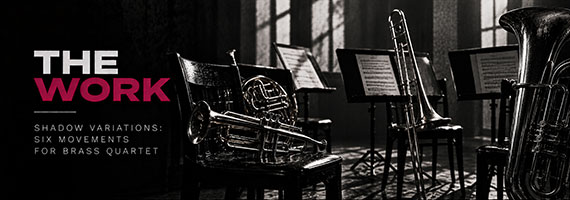
Each episode I take you behind the score into the how, the why, the constraints, the engineering, the hidden scaffolding that makes each piece feel inevitable. The small decisions that look harmless on paper then biked in the mix. Tonight, we're stepping into the next release in the Shadow Cycle, Shadow Variations: Six Movements for Brass Quartet. It's out now on all streaming platforms. And this time, the ensemble changes the problem once again. Because brass is not just another color.
01:40
It is air under resistance. Horn, trumpet, trombone, tuba. Four metal bodies. Four ways of shaping breath into resonance. Four ways of making stillness feel heavier than silence. Shadow variations continues the pausing point commission world that began with shadow attitudes and expanded through shadow intervals and interludes. A quick recap if you're joining the cycle here. The design logic is simple on the surface.
02:17
Each piece is built around a specific breathing pattern set at 60 beats per minute. The music becomes a timing environment, not a click track, rather a musical structure that the body can innately follow without feeling shouted at. The breath pattern shapes the form. When the breath rises, the anchor line rises. When the breath holds, the anchor holds. And when the breath releases, the line descends. That anchor has changed with each album.
02:55
In shadowitudes, it lived mostly in the piano's left hand. In shadow intervals, it often moved through the cello. In shadow interludes, it's settled into the bassoon. And here in shadow variations, it goes deeper again. The tuba holds the floor. Same breathing architecture, different body. The six movements follow the same pausing point states of focus, energize, calm, relax, balance, and unwind. But this time the question is not how do we guide the breath.
03:39
This time the question is what happens when breath has to move through metal first. After piano strings and woodwinds brass felt like the next pressure chamber. Piano is clean. Strings are continuous. Woodwinds are familiar with breath. And brass is physical in a different way. You cannot separate brass sound from force. Even quiet brass has a mass. It has a body. It has a bell. It has tubing.
04:18
It has a little bit of a forceful edge even when behaving beautifully. That's what made it interesting for this project because these pieces are not meant to be fanfares. They are not battle music. They are not arrival music. They are not announcement music. They are breathguided works. So the challenge was almost backwards. How do you take an instrument family so associated with power, ceremony, signal, warning, victory, announcement and make it hold a pause? How do you ask brass to whisper without pretending that it is not brass? That became the central tension of shadow variations. Not brass as volume, brass as pressure control.
05:18
Why variations, you might ask? Because by this point in the shadow cycle, we are not inventing a new breathing system each time. We're taking the same underlying architecture and passing it through different bodies. Piano, strings, woodwinds, brass. Same breath counts, different physics. That is variation, not decoration. Variation as an experiment. What changes when the anchor moves from left hand to cello to bassoon to tuber?
05:58
What changes when the breath cue is struck, bowed, blown, then pressurized? What changes when the same 478 pattern becomes not a corridor of piano time, not a string suspension, not woodwind air, but a brass chamber. That is the album. Six movements, six breathing architectures, one brass quartet testing how much weight quiet can carry. Each movement is titled Aerys. Aerys is one of those words that felt almost too perfect.
06:44
On one hand, it can mean air, [clears throat] sky, or atmosphere. On the other hand, its origins also mean raw copper, bronze, or metalbased objects. So, the title sits in the exact place this album lives. Air and metal, breath and object, a soft human mechanism moving through something hard and resonant. That's the whole sound world. Brass is never just breath. And it is never just metal. It is a negotiation between the two.
07:25
AIS 1 through six. Six movements for a quartet that can sound golden, smoky, ceremonial, tender, absurd, severe, and quietly haunted. Sometimes in the same phrase. Let's talk briefly about the tuber because in this album the tuber is not comic relief. It is not the elephant in the orchestra corner. It is not the big low one doing big low things. The tuba is the anchor. It is the instrument that most often carries the baseline indicating the breathing pattern. Inhale. The line rises. Hold. The line sustains. Exhale. The line descends.
08:18
The tuber makes that feel embodied. Not because it is subtle in the usual sense, but because low frequencies give the body something to believe. You don't just hear the floor, you feel where the floor is. That matters in breathguided music. If the listener's mind wanders, and it will, the anchor needs to stay visible in the dark. It needs to be findable without becoming bossy. The tuber can do that. It can sit confidently underneath the texture.
08:57
The horn, trumpet, and trombone can color, answer, open, brighten, interrupt, and move. But the tuber knows where the body is. There is a specific challenge in writing functional music for brass. If you make it too intense, it becomes attentionseeking. If you make it too neutral, it just becomes beige. And brass does not forgive beige. Brass wants contour. It wants direction. It wants a reason to enter.
09:35
So I had to think of the quartet less as a block and more as a pressure system. The trumpet can act like a blade of light. The horn can round the edges and make the harmony feel internal. The trombone can shift between warmth and architecture. And the tuber holds the pressure chamber together. The trick is not to remove brass identity, but to discipline it. Keep the gleam, keep the weight, keep the possibility of force, but put it behind glass. That to me is where the noir lives in this release. Not in darkness, rather in restraint. the feeling that the sound could become large but chooses not to.
10:32
AIS one follows the focus pattern box breathing. Four in, hold for four, four out, hold for four. This is the most structurally stable breathing pattern and in brass it becomes almost architectural. The tuber sets the contour. A rise, a hover, a fall, a hover. The other instruments build around it. But the point is not to clutter the square. The point is to reinforce it. Aerys one feels like brass learning to breathe inside a frame.
11:15
No grand announcements, no fanfare, just a controlled signal. Focus here is not sharp productivity. It's more like aiming a lamp at one corner of the room. The room is still dark. You just know where to look. Heat. Heat.
12:59
Aerys 2 follows the energize pattern. Inhale for four, exhale for two. Short cycle, quick return, brighter pacing. In earlier albums, Energize found its energy through piano articulation, string piticato, woodwind attack. With brass, energize becomes a signal, not an alarm, a signal, a phrase that has to move quickly but not become frantic. Brass can tip into command very fast. One wrong gesture and suddenly we're not breathing, we're marching, so air is too needed control. Shorter cells, cleaner exits, a sense of forward motion without shouting.
13:49
The trumpet brings the brightness. The horn keeps the sound rounded. Trombone and tuber keep the rhythm grounded enough that the energy does not float away. Because energize in this context is not panic. It is ignition without combustion. A match struck in a closed room. Heat.
15:32
Aries 3 follows the calm pattern. Inhale for four, hold for two, exhale for six. This is where the longer exhale begins doing the work. In brass, that longer exhale has a different emotional weight. With woodwinds, the exhale felt fragile because the sound implied the body running out of air. With brass, the exhale feels like pressure being released from something sealed, a valve opening, a room depressurizing. a held signal softening at the edges. The twocount hold is brief, but it matters. It gives the phrase a hinge, a little suspended moment before the longer descent.
16:25
Aries 3 is where the quartet has to soften without losing its edge. And that's a strange balance. Too soft and the sound loses shape. too present and the calm becomes performative. So the writing lives in slow arcs, stable pulses and small harmonic shifts. Enough movement to process, enough repetition to settle. Heat. Heat.
17:36
Heat. Heat. Heat. Heat.
18:31
Aerys 4 follows the relax pattern. Inhale for four, exhale for six. No holds this time, just a longer release. This is one of my favorite patterns to translate because it has such a simple emotional grammar. Take everything in and then linger on the exhale for a little longer. The music doesn't need to explain itself, but brass complicates that simplicity because a sixcount exhale in brass can easily feel too declarative if you let the line bloom too much. So Aries 4 became about softening the brass body, letting the phrase bend, letting harmony move without announcing that it has moved, letting the tuber keep the breath contour steady while the upper voices release into it.
19:29
The goal is not to make brass disappear. The goal is to make brass exhale. There's a difference. Disappearing is absence. Exhaling is presence letting go. Heat. Heat.
21:10
Heat. Aries 5 follows the balance pattern. Inhale for five and exhale for five. Symmetry but not square. Five always feels slightly strange. It is balanced, yes, but it does not sit with the obvious stability of four. It has a gentle tilt which makes it perfect for balance because balance is not stillness. Balance is constant adjustments.
21:54
A body staying upright through tiny corrections. In this movement, the tubers rise and fall keeps the breath honest. Equal inhale, equal exhale, no hold, no bargaining, just a steady exchange. The upper brass can stretch over that, creating a kind of suspended weightlessness above a very grounded floor. That contrast matters. Balance is not everything becoming equal in color. It is different weights agreeing not to collapse. Horn, trumpet, trombone, tuber, different pressures, one shared center.
22:52
Heat. Heat. Heat. Heat.
24:03
Aries 6 follows the unwind pattern. Inhale for four, hold for seven, exhale for 8. The long corridor returns. Every album in this cycle eventually has to face this pattern, and every ensemble tells the truth a little differently. On piano, 478 was a time signature problem. How do you make four then seven then eight feel like one breath instead of three glued together rooms with strings? The seven count hold could become suspension. A long harmonic body held in the air.
24:50
With woodwinds the hold became fragile because breath was so literal. With brass the hold becomes pressurized. Seven counts of contained resonance. Not moving yet, not releasing yet, just held. The exhale then becomes a controlled unwinding of that pressure. Not collapse, not defeat, a deliberate release. This movement feels like the album walking itself down a staircase in the dark.
25:26
slowly, carefully. No theatrics, just the system choosing to loosen. Heat. Heat.
26:24
Heat. Heat. By this point, the Shadow Cycle has become kind of an instrument lab.
27:02
Each album asks the same question through a different body. The piano asks, "Can a simple line guide breath through clarity?" Strings ask, "Can a group sustain breath through contact?" Woodwinds ask, "Can breath guide breath?" And brass asks, "Can pressure become calm?" That last question is the one most interesting here today because pressure is usually what we're trying to escape. Pressure at work, pressure in the body, pressure in the mind, pressure to respond, produce, perform, appear fine, keep going.
27:50
But pressure is not always the enemy. Unregulated pressure is the problem. Brass understands this beautifully. Too much pressure and the tone cracks. Too little and the tone doesn't speak at all. The whole instrument family lives in that negotiation. And maybe that's why it belongs in this cycle. Breath work is also pressure negotiation, not forcing the body into a calm state. Not bullying the nervous system into silence, just giving it a pattern stable enough to follow. Aries is that idea coated in metal.
28:38
So how best to listen to shadow variations? If you want the full ark, listen in order 1 through six. If you want to use it for breathing practice, choose the movement that matches your moment. AI is one for structure. AS2 for ignition. AS3 for downshifting. AS4 for release. AS 5 for steadiness. AS 6 for the long exit. And if your mind wonders, good. That's baked into the design. The tuber will still be there.
29:17
The pressure will still have a flaw. The breath cue will still be waiting when you return. So, what's next? Shadow variations is another step forward in the larger experiment. Shadow Attitudes was the solitary instrument. Shadow intervals was the first ensemble. Shadow interludes turned towards air. Shadow variations, explored pressure. The next releases will keep widening the frame. New textures, new bodies, new ways of asking the same question. How can music guide breath without becoming a product demo? How can it have function and still survive as art?
30:06
Science and shadow sharing the same air, or in this case, the same brass chamber. Shadow Variations, Six Movements for Brass Quartet is out now on all streaming platforms. If you listen, tell me which AIS stayed with you, the one that kept resonating after the room went quiet. And if you're listening to these releases as breathing tools, and you want more sessions built around the same ideas, check out the Pausing Point app. That's where the wider library lives. More guided music, more soundsscapes, more small deliberate interruptions in a life that doesn't stop asking. Sometimes you don't need more time, you just need a better pause. Thanks for tuning in. I'm SRNMC and this has been Shadow Scores.